Founded in Vilnius in the early 2010s by grad_u, Greyscale has grown from a personal vision into one of the genre’s most respected and forward-thinking imprints.
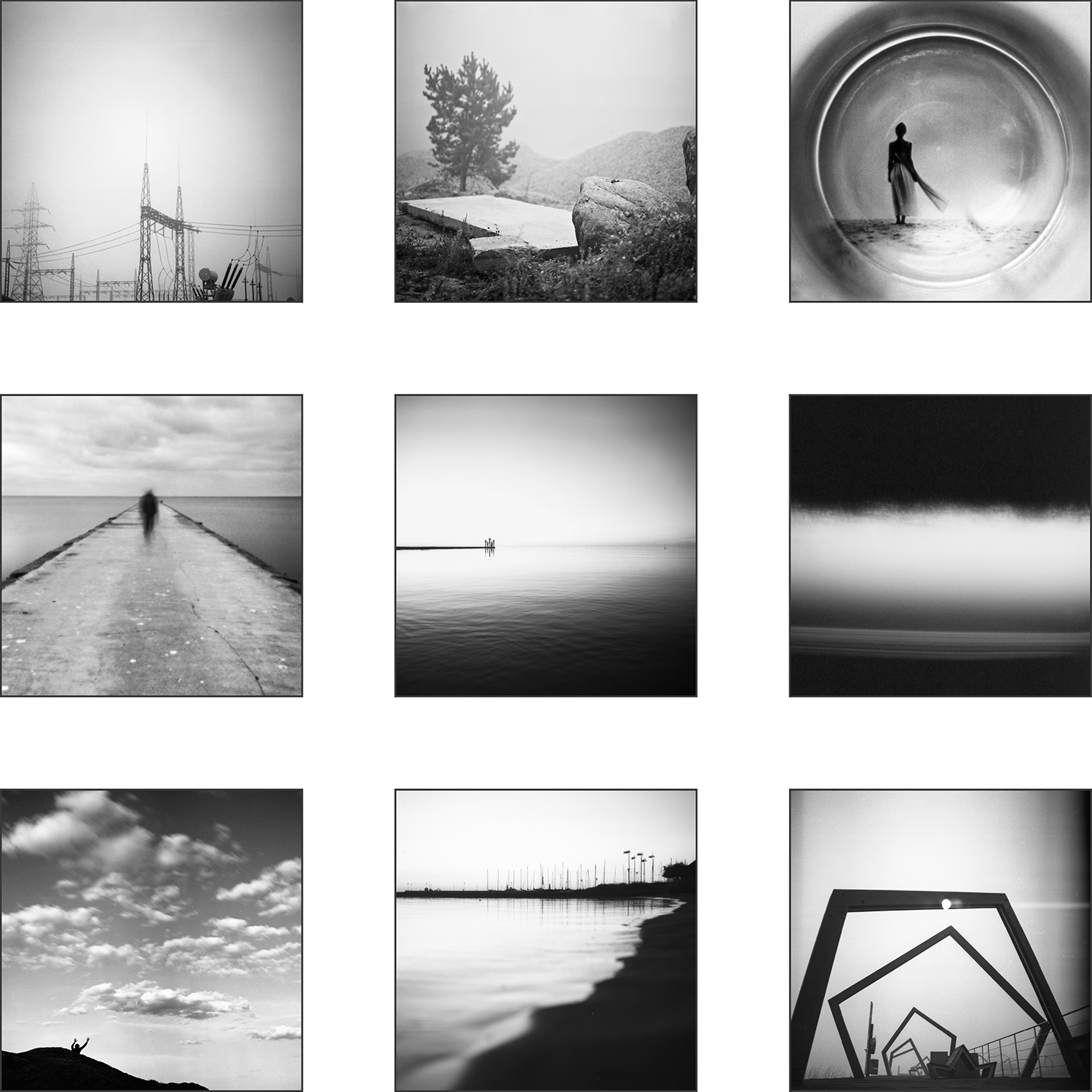
Rooted in minimalism, the label bridges sound and visual art through the analog photography of Rima Prusakova, creating a world where depth, patience, and emotion coexist.
Across its many series — from immersive CD albums to collector vinyl, DJ-oriented tools, and digital experiments — Greyscale continues to refine and expand the language of dub techno and derivates.
In our latest “Behind the Label”, we explore Greyscale’s vision, philosophy, and evolution — through the words of its founder and dub techno craftsman grad_u. As part of the feature, grad_u crafted an exclusive label mix, weaving together tracks from across the Greyscale catalogue — a fluid narrative that captures the essence of the imprint’s sound and evolution.
☉ Do you remember the exact moment when you decided to found the label? What vision guided you in that choice?
“Back in 2010, I was already recording a lot of music and releasing it here and there when a few friends and I launched a small netlabel. It didn’t last long, but it taught me an important lesson: if I wanted to do this seriously, with consistency and a clear artistic vision, I needed full control over how things were done. That idea became the foundation for Greyscale. In the beginning, the label was simply a platform for my own projects. The first releases — Surface Variations and Endless Space — were deeply personal albums, and Greyscale gave me the freedom to decide exactly how and when they would see the light of day.
But from the start, I knew the concept was meant to be bigger than just my music. I wanted to create a space where sound, visuals, format, and curation worked together to form one complete artistic statement. That focus later opened the door to working with other artists. By the third release, the label was already evolving into a curated platform that reflected a much broader vision of dub techno.
At the same time, I launched Redscale, which was dedicated purely to my own productions on vinyl. Both projects were built on the same principle: creative control and a deeper purpose — to treat dub techno not just as a genre, but as an art form worth archiving, refining, and pushing forward. Once artists saw how carefully we approached every release, they started sending their music too. That’s how the Greyscale family started growing into what it is today.”
☉ What inspired the name Greyscale? What does it represent for you, and how is it reflected in the music you release?
“When I started shaping the idea of Greyscale, the name wasn’t an afterthought. It was one of the first essential pieces. I can’t really begin any project until the full concept is laid out, and once I found the right word, everything else started to fall into place.
I wanted the label to reflect the qualities that define this music at its core: minimalism, subtle evolution, and the beauty of small changes over time. But I also wanted to connect that idea with another important part of my world — analog photography — which my wife was deeply involved in at the time. That connection turned out to be the key.
Dub techno, to me, has always felt like autumn weather: rain, fog, shifting light, and endless shades between black and white. It’s not about extremes, but about the space between them — the textures, moods, and nuances that reveal themselves over time. Black-and-white film captures that essence perfectly. It’s about detail and silence without distraction.
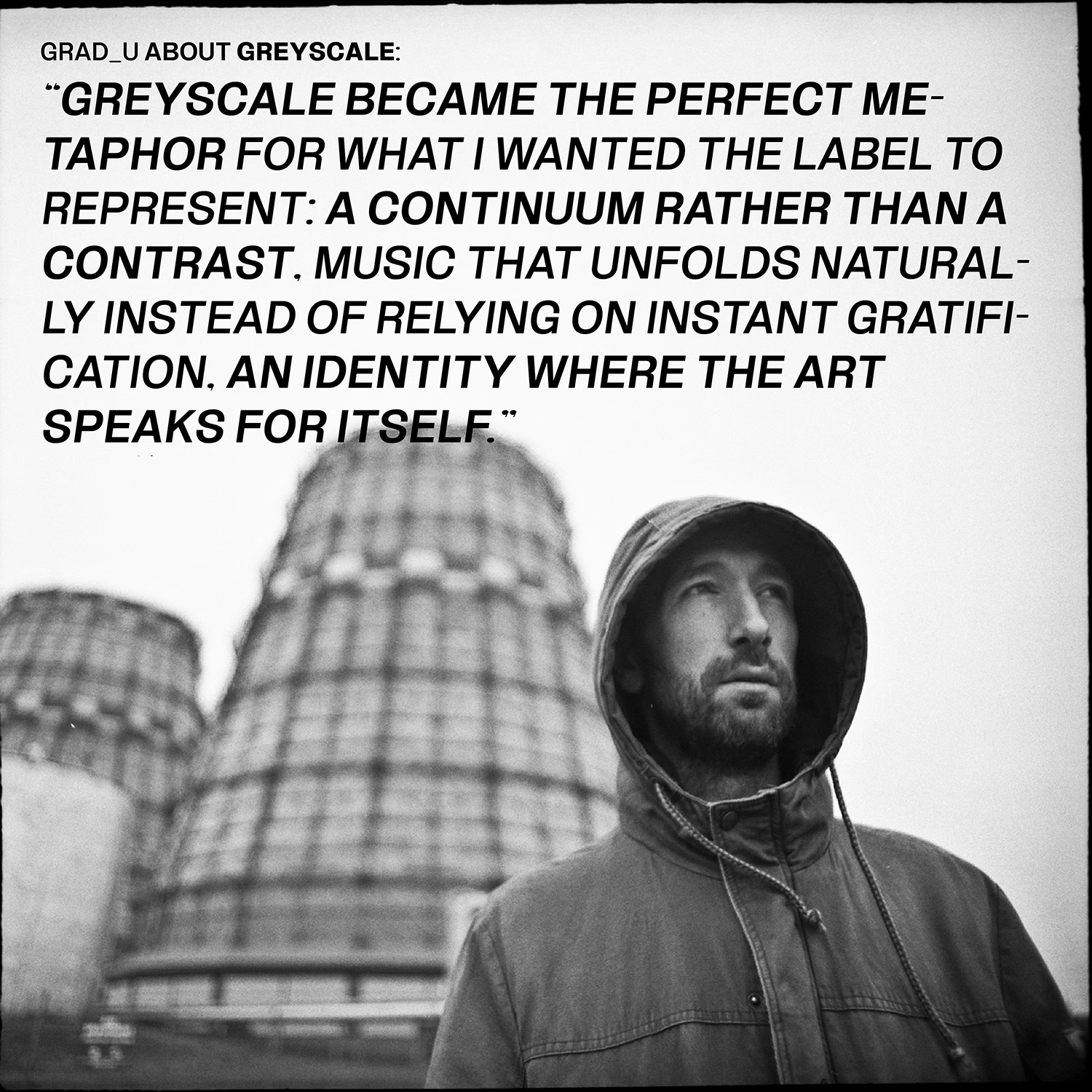
“Greyscale” became the perfect metaphor for what I wanted the label to represent: a continuum rather than a contrast, music that unfolds naturally instead of relying on instant gratification, and an identity where the art speaks for itself. Even when we later introduced the Spectrum series, adding carefully curated color into the visual world of the label, the same philosophy remained. It wasn’t a departure from Greyscale’s concept, but rather an evolution of it.“
☉ How does the concept behind Greyscale differ from Redscale?
“Greyscale and Redscale were born together in 2012 and released their first records within the same month. They were designed as sister labels from day one, each with its own purpose but sharing the same creative vision.
The idea was simple: Greyscale would focus on long-form works, initially CD albums — starting with my own — while Redscale would be a vinyl-only outlet for my personal productions and experiments. Over time, both evolved. Greyscale expanded into vinyl and a digital-only Mood Series, while Redscale’s music became available digitally and was even compiled on CD for collectors. But the true difference was never about format — it was about intent.
In practice, Redscale has always been my creative laboratory: a space where I can explore new ideas, take risks, and follow instincts without compromise. Greyscale, meanwhile, functions more like a gallery — a curated environment where like-minded artists can present their work alongside mine, where the music is chosen purely on its artistic merit. We’ve never cared about chasing big names. We’ve released debuts from completely unknown artists who later broke through to respected labels, and that’s a part of the mission I value deeply.
Today, Greyscale’s catalogue includes music from more than 150 artists across every continent, showing how widely this shared vision resonates.
The visual identities reflect those conceptual differences too. Greyscale is rooted in black-and-white photography, with gradients, shadows, and the subtle transitions between light and dark. Redscale draws from “redscale” film, where shooting from the reverse side tints images in shades from deep yellow to maroon and almost black. Even the first tracks carried coded names like EV1, EV2, and EV-5 — “exposure values” that hinted at their relative brightness or darkness.
Sonically, Redscale has evolved from classic dub techno toward a more stripped-down, club-oriented sound, while Greyscale remains a broader platform for deeper, more varied expressions of the style. Together, the two labels complement each other: one as a laboratory for experimentation, the other as a gallery of carefully curated works — forming a complete picture of what dub techno means to me.“
☉ How do you select the photographs by Rima Prusakova for each release?
“From the very beginning, photography wasn’t a secondary detail. It was part of the foundation of Greyscale’s concept. I’ve always seen Rima not just as a photographer, but as an equal creative partner — and also my wife, which makes the whole project even more meaningful.
In the early days, it was almost like an unspoken agreement: I would provide the music, and she would provide the visual world around it. That dynamic is still true today, though her role now extends far beyond photography into product presentation, marketing, and more.
To me, Rima acts as the label’s true art director. She has complete freedom to shape the visual identity the way she feels is right, and I trust her taste completely. Her photography has a very distinctive atmosphere, and artists often comment on how perfectly it complements the music. The way she selects images is always deeply intuitive.
All the visuals for Greyscale are shot on analog film — either 35 mm or medium format — and developed and scanned by hand. Most of the time, she chooses an image from her archive based purely on the emotional character of the release — not a literal depiction, but something that feels like the music. Other times, we’ll go out specifically to capture something unique for a particular project.
That level of care and craft is a huge part of why Greyscale feels cohesive as a label. The music and imagery evolve together, building a world that’s more than the sum of its parts. And the fact that it’s something we build together as a family makes it even more special.“
☉ Is there a direct connection between your personal musical background and the artistic direction of the label?
“Absolutely. The artistic direction of Greyscale is deeply connected to my own musical background. I’ve been involved in electronic music for almost three decades now, starting as a DJ back in 1997.
My first real encounter with dub techno came in the late 1990s, when a local radio show dedicated several weeks to the sound. They were playing releases from Chain Reaction — including Fluxion’s Vibrant Forms, Monolake’s Hongkong, Vainqueur’s Elevations — and many others. That was my first real introduction to this world. Even though I was playing very different music at the time, something about that atmosphere, depth, and restraint resonated with me immediately.
The real turning point came a few years later, around 2005, when I heard Fluxion’s Prospect II again by chance. The very next day in the studio, I tried to capture that feeling myself — and that’s how the grad_u project was born. From that moment on, I dedicated myself completely to exploring dub techno as both a producer and DJ. That long history — nearly three decades of listening, playing, producing, and living inside this sound — is what shapes Greyscale’s artistic direction today. It’s the filter I use to decide what belongs on the label and what doesn’t.
My curatorial approach is a balance of both preserving and evolving. I have a deep respect for the roots and the classic sound that defined dub techno in the late ’90s and early 2000s, but I’m equally interested in how it can grow and transform without losing its essence. That philosophy remains the guiding principle behind every Greyscale release.”
☉ Could you give us an overview of the different series published on the label, and briefly explain their characteristics and differences??
“Each series on Greyscale exists for a reason. They’re not just different formats or catalog segments, but different ways of exploring and presenting the same artistic vision. Together, they form a kind of ecosystem where each branch plays a specific role in shaping the overall narrative of the label.
The CD album series is the foundation — the heart of what we do. These are full-length works designed to be experienced as complete journeys, often telling a story across 60 to 79 minutes.
The main vinyl series is the flagship for our EP releases, featuring original tracks and remixes by iconic artists like Deepchord, Fluxion, Steve O’Sullivan, Deadbeat, VRIL, Yagya, and more.
The Exposure series is built with DJs in mind: a compilation line that balances dancefloor functionality with Greyscale’s atmospheric depth.
The Archive series is about preservation, giving important music that was never pressed on vinyl a proper physical edition.
The Spectrum series introduces color into Greyscale’s monochrome aesthetic — released as 10-inch limited editions exploring slightly different sonic and visual territories.
The Mood series focuses on digital releases with a quicker turnaround and a broader stylistic range. Some of its tracks later evolve into vinyl editions, making it a creative testing ground for the label’s evolving sound.
Each of these series contributes to one unified idea: presenting dub techno across multiple formats, moods, and contexts — from long-form storytelling albums to focused club tools and experimental hybrids.“
☉ If you had to describe the label’s sound as a percentage between dub and techno, what would it be?
“It’s difficult — and maybe even a little misleading — to describe Greyscale’s sound in strict percentages, because the whole idea is about how those elements interact rather than how they’re divided.
Dub is the foundation: it brings the depth, space, texture, and patience that give the music its timeless quality. Techno provides the framework — the pulse, tension, and forward motion that keeps it alive and evolving. And quite often, a third essential ingredient enters the mix — ambient — adding atmosphere, dimension, and emotional weight.
The goal isn’t to sit exactly in the middle, but to erase the boundaries between them — to create music where rhythm and space, structure and atmosphere, coexist as one. And the beauty of that approach is that it’s never exactly the same twice.“
☉ Dub techno has experienced a strong resurgence in recent years. How has this influenced Greyscale? What’s your take on it?
“To be honest, we’ve always been fully committed to this sound, long before anyone started talking about a “resurgence.” The renewed attention around dub techno is great to see, but for us it hasn’t changed the mission at all.
One of the most positive aspects of this new wave is that it’s introducing more people to the music — new listeners, new DJs, new producers — and that energy is healthy. But with every wave of interest comes a lot of superficial imitation: music that mimics the aesthetics but misses the depth.
That’s where I think our role becomes even more important. Our aim has always been to set a standard — music that endures, that resonates long after the echoes fade.“
☉ What are the future perspectives and goals for the label?
“I’ve never been the type to announce big plans in advance. Most of what we do at Greyscale is built quietly behind the scenes and only revealed when it’s fully formed. That’s how we’ve always worked, and that approach won’t change.
The mission remains the same: to release timeless music with depth, substance, and character. But Greyscale will always evolve. As long as the sound reflects subtlety, atmosphere, and emotional weight, we’ll keep exploring new forms and territories.
Everything we do next will follow the same principles that have guided us from the start — quality over quantity, substance over hype, and a deep respect for the art form.“
☉ You’ve recorded a mix for us made entirely of tracks from the Greyscale catalog. What should we expect?
“I approached this mix as more than just a collection of tracks — I wanted it to feel like a story that captures what Greyscale is all about. It spans the full spectrum of our sound, from deep ambient landscapes to immersive dub grooves and hypnotic, dancefloor-focused pieces.
It’s not about promotion — it’s about perspective, about framing a decade-long journey into a single, continuous moment that tells the story of Greyscale without words.“