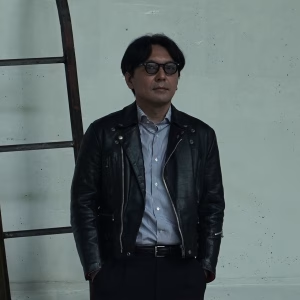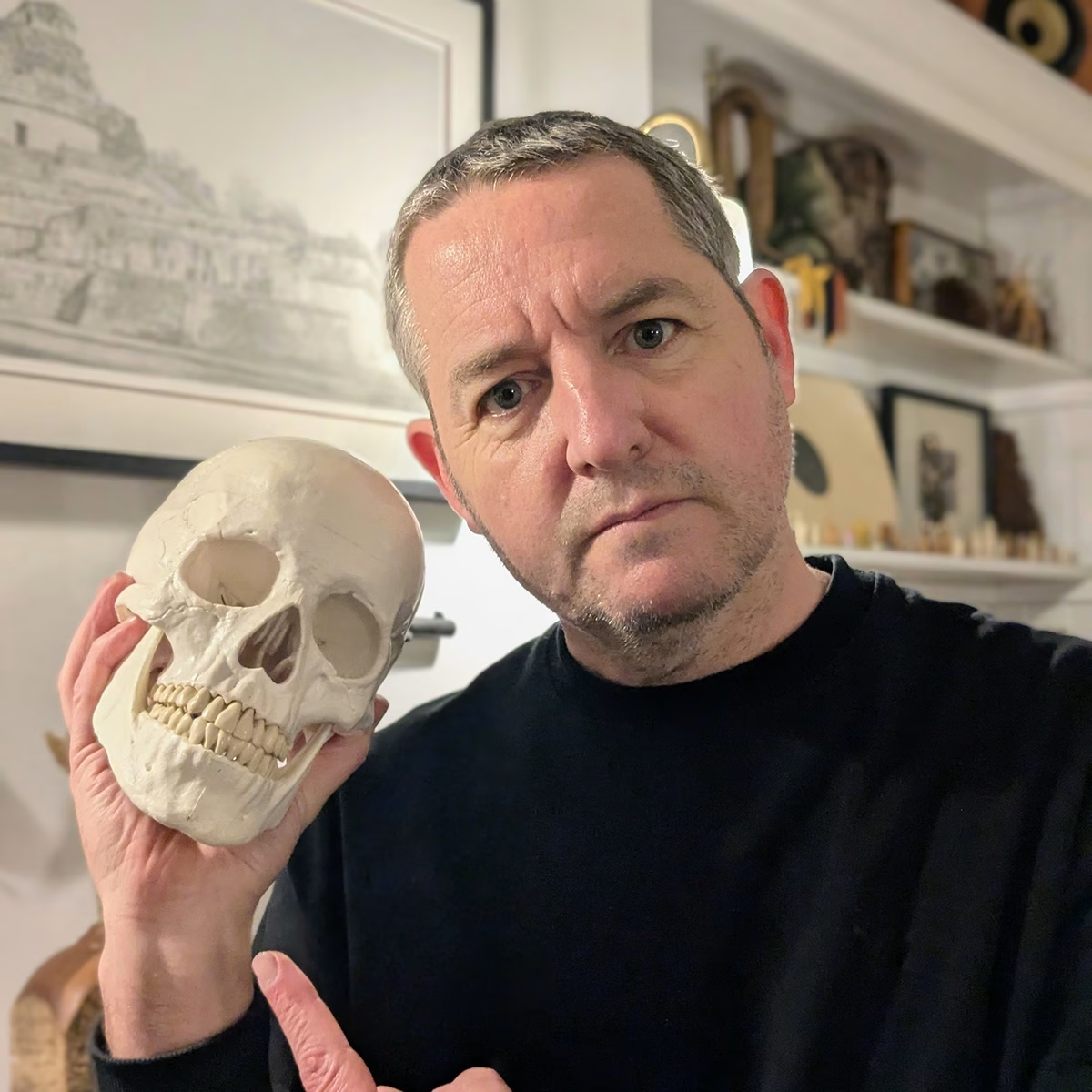
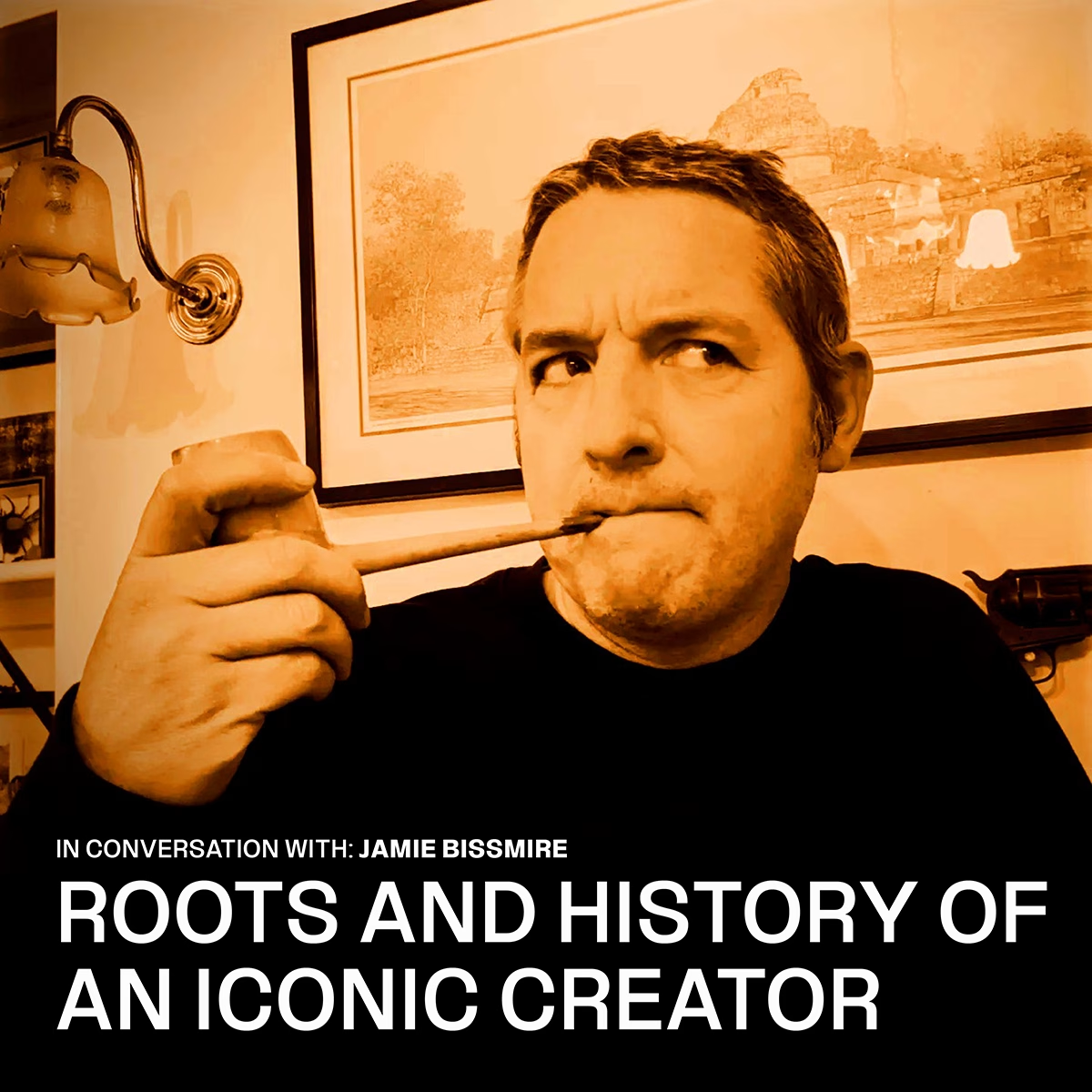
Palpebrae is pleased to share an amazing content regarding one of the most important icon of the Techno scene in the UK: Jamie Bissmire. The artist, born in London, raised his figure as artist since the 80s approaching to music in different ways and then keeping a focus to the electronic. He his the wonderful mind behind different labels that made history of the scene in the late 90s like Ground Records, Foundation Records and 50hz, to name a few. His productions has moved dancefloors all around the world and those still keep kick in. His latest releases on EVOD Music, No Signal Records and Molecular Recordings draw up his coming back in the game. Here we share an interview where we are going to talk about his growth and all the experiences that lead him to be the artist that we know, and an amazing vinyl-only Techno podcast recorded by himself.
Have a good reading and listening!
☉ First of all, we’d like to ask you: what is your first memory that connected you to techno music?
“My first memory of techno music dates back to 1988, on the dancefloors of the underground clubs in London. DJs like Colin Favor, Danny Rampling, and Trevor Fung played a mix of tracks that helped shape the UK dance scene—and likely the global one. The music was incredibly uplifting and unifying—an amazing time for dance music. In one night, you’d hear everything from New York and Chicago house to Balearic, alternative pop, and new beat—a true melting pot of styles. Two tracks that stood out to me were Strings of Life by Derrick May and Nude Photo by Rhythm Is Rhythm.
Techno resonated with me because it had a futuristic element that set the tracks apart. Growing up in the ’70s, I was always fascinated by anything space-related or futuristic—whether it was the space race, sci-fi art, Jean-Michel Jarre, the BBC Radiophonic Workshop, or the TV and films of that genre. The subject matter fascinated me. One of the first albums I bought was Force Majeure by Tangerine Dream in the late ’70s, so techno felt like a natural home for me.
I soon hunted down all the techno I could find, although in the early days it was extremely difficult to come by. Ben Long and I would travel down to Brighton from North London to a shop called Jelly Jam, where Dave Clarke and Luke Slater worked (unknowns at the time), just to pick up a record or two. Later, Fat Cat Records opened on Monmouth Street in central London, which was a godsend for the techno scene at the time.”
☉ How did the idea to become Jamie Bissmire, the producer and DJ we all know, start to grow in you?
“Becoming a DJ and music producer wasn’t a conscious decision—it happened organically. I started by collecting records that inspired me on the dancefloor, then bought turntables and a mixer. After nights out, my friends and I would head back to my place, mixing records for hours and experimenting with blending different genres with house music. I then moved on to playing house parties in and around London. One memorable party early on was in a mansion in South London, owned by a gangster who at the time was alledgely doing a strech in prison. Hundreds of kids turned up, It was absolutly packed and everyone was off thier head on ecstasy. That night I played alongside Steve Lee, Paul Oakenfold, and a few other London DJs at the time, it was absolutly nuts in there—this was around 1989.”
Besides great solo releases on various imprints that shook up the scene in the late ’90s, you were part of different projects such as Bandulu with John O’Connell and Lucien Thompson, and the duo Space DJz with Ben Long. Both projects had different approaches to electronic music.
☉ Can you tell us more about these projects?
“Bandulu was born out of a love for ’70s roots music, electro, and dance music, which we also began collecting and listening to throughout the ’80s. Fusing our earlier influences with house music felt like a natural progression—it wasn’t something we intellectualized, it just happened. Similarly, with the Space DJz, Ben, Lucien, and I were deeply into the electro scene in the early ’80s, breakdancing, and running around London graffitiing. One of our graffiti pieces even ended up in the seminal Spraycan Art book by Henry Chalfant, so it was only natural to incorporate these elements into our music.”
During the ’90s, you founded two great labels, Ground Recordings and 50Hz.
☉ How was running labels during those years, and what was the main concept behind the two labels?
“I think that each and every one of them has something special in me, because being able to work with these artists that I mentioned on their Infonet Electronic Recordings was the first record label I helped set up, alongside Chris Abbot, who at the time was in a relationship with my sister Natalie and lived at my family home in Muswell Hill. Chris was subjected to a barrage of techno music morning, noon, and night he also worked at Creation Records and was deeply involved in the London club scene in the late ’80s and early ‘90s. Chris pitched the idea of a dance music subsidiary label to Alan Magee of Creation Records, and Infonet Electronic Recordings was born in 1991 as an outlet for underground techno. Chris made some great connections in Detroit, and our home in Muswell Hill became a stop-off for any Techno artists visiting the UK from Detroit at the time—Mike, Alan, Carl, Suburban Knight, Rolando, Kenny, and many more.
In the ’90s, Bandulu produced two albums for Creation Records before signing with Jeff Travis at Blanco y Negro in 1995. However, the relationship stalled Bandulu’s progress, and after a year without releasing any music, we decided to start our own label, Foundation Sound Works to release the music Blanco y Negro refused to put out.
Later that year, I went on holiday to Mexico with my then-girlfriend, Andrea Parker. We stayed with friends—Gordon (R.I.P.) and Jennifer Gilchrist—whom my family had met during a previous trip to Mexico in the ’80s. While we were on Cozumel, Gordon introduced me to a book he had read years earlier, The New View Over Atlantis. This book played a significant role in shaping and inspiring the creation of Ground.
When I returned home, I threw myself into developing my own take on techno, drawing deeply from ancient English history, my personal connection to Stonehenge and other historic sites, which I had been visiting with Mum, Dad, sister and our Afghan Hound Kassim since childhood. This became an essential part of my creative process. It felt as though I was reconnecting with something ancient within myself, grounding my music in a history that had always been present, yet somehow hidden.
After I had said what I wanted to with Ground, I met Paul Langley and DJ Bam Bam around 2002, who inspired me to create a new label, 50Hz, heavily influenced by early Chicago artists and mixing Techno to create—Jacking Techno. Paul, DJ Bam, Alex Peace, and I had some really good musical sessions together and made some great music along the way—a fun time all around. During all of this, I was also working closely with Ben Long on our Space DJz project, creating releases for Soma, Infonet, NovaMute, Jackstar, Kombination Research, and many more. We also developed our unique four-turntable and two-mixer DJ show, the very first, way back in the early ’90s.”
There was a time when you stopped producing music and performing as a DJ.
☉ What led to this strong decision?
“After my wife Bonnie and I had children, I put the brakes on my music career, as I found it near impossible to dedicate enough time to DJing, making music, and looking after my kids. I was fortunate to be able to take time off to raise my family.”
☉ How was life after you left behind music, and what are your other interests besides it?
“Life after music was fantastic. I’m so glad I took the time off to look after my kids and raise them properly—it also helped give me perspective on my music career. Other interests include my love of cars. I’ve owned a few interesting vehicles over the years, one being a Mitsubishi Evo 8, which I regularly took to the Nürburgring and various track days. On my very first Father’s Day, the car was stolen, which I took as a sign to slow down and build a custom car from a 1968 Rover P5B. This has become an ongoing project and family vehicle. The other hobby I took up again was drawing and sculptur, which I enjoy immensely.”
Lately you came back in the game with some amazing releases like the one on Evod Music and the vinyl on No Signal Records. Both of the releases remind of your unique style of techno you made before but in a modern key way.
☉ Did the new techno influence your music?
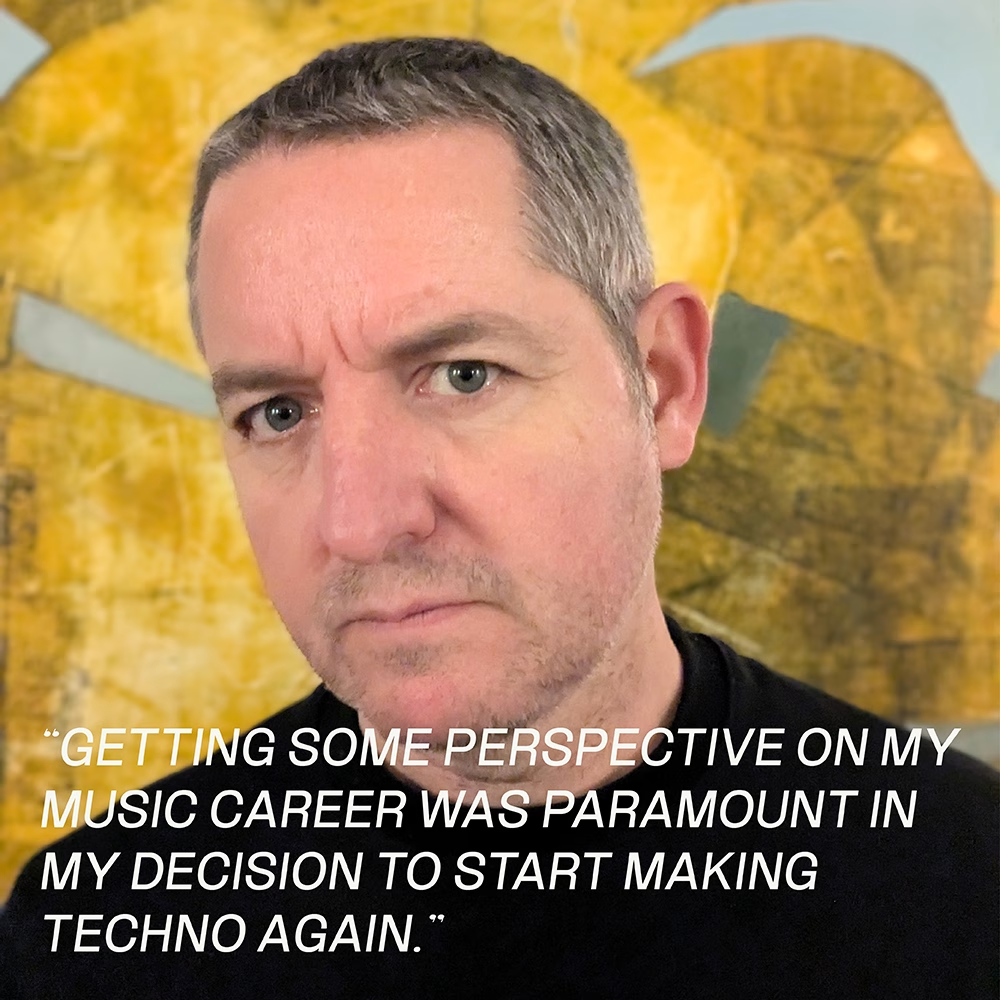
“Getting some perspective on my music career was paramount in my decision to start making techno again. My philosophy was to pick up where I left off with Ground, as I felt that was my personal sound and contribution to techno. A good friend, Leon Michener, who I made music with back in the late ’70s as a young boy (I played drums and Leon had a Roland synthesizer), once told me: “You found your sound, now keep rearranging the furniture.”
☉ What is your main approach when you start a track? Are you looking for something fresh, discovering new sounds, or do you stick to your guns? Do you think analogue will always keep its fascination, or can digital replace it completely?
“My approach to starting a track is simple: Roll a big joint, turn on my machines, and use the language of play engage my creative brain. I’m not a fan of the digital world per se— I find it a soulless place to be creative, it always seems to be seeking perfection, humans aren’t perfect; we’re analogue. Honestly, I find a lot of today’s Techno, even though it’s produced flawlessly, to be soulless. Sure, your kick drum is tight, and every sound is perfectly placed, but for me, that’s not what Techno is about. Techno is about mood and vibe, and what happens between the sounds is just as important as the sounds themselves. If you polish a track too much, you strip away its soul. There’s seems to be an invisible line between analog and digital, and while it’s fine to use some digital elements, once you cross too far into the digital realm, something gets lost. And this applies to everything—art, design, cars, music, architecture. If you stay mostly in the analog world, you can’t go too far wrong imo.”
☉ Which one is your setup for making music?
“My setup is all analogue—no digital in my music-making process at all. I have a computer in my studio, but I only use it to record from my two-buss on my mixing desk. I’ve been using Modular systems, drum machines and keyboards since day one, it’s just where I feel comfortable. I make a track and mix it down there and then, end of story, no stems, no reloads, no nonsense.”
☉ One of your releases that will stay in your heart forever?
“My first release on Ground, Timaeus, which later became known as The Number and Measure. I remember the night I made that sequence and sound—it was so alien. I just let it run for a good hour, getting my brain used to it before I mixed the track. I felt I had definitely found a bit of the Techno canvas that no one had painted on before, very exciting.”

![In conversation with: Juan Rico [Reeko, Architectural]](https://palpebrae.com/wp-content/uploads/2026/02/interviews-1-300x300.avif)